Have a personal or library account? Click to login
Professionals' naming of intellectual disability, past and present practice and rationales Cover

Professionals' naming of intellectual disability, past and present practice and rationales

Open Access
|Jun 2012

Figures & Tables

Table 1. An overview of terms in use previously or now utilised by professionals – research question 1

Diagnostic termPreviously in usePresently usedFeeble-minded (Åndssvak)210Mentally handicapped/deficient (Evneveik)160Mongolian/mongolism (Mongoloid)100Mental developmental disability (Psykisk utviklingshemming/-hemmet)3532Person with mental developmental disability (Person med psykisk utviklingshemming)716Developmental disability (Utviklingshemming)1530Mental retardation (Mental retardasjon)2220General or comprehensive learning difficulties (Generelle/sammensatte lærevansker)310Total terms referred to in this table129108

Table 2. Discursive explanations of why terms change (research question 3). Number of informants supporting the different explanations plus examples of supportive statements voiced by them
Explanations of changes in form of discourses heldOriginally proposed hypotheses of changesNExamples of statementsImpact from an educational discourse emphasising ethics among practitionersNegative effects of stigma35The term ‘mental’ is stigmatizing The PUH-concept is the most stigmatizing. It has low statusEthical conscientisation31One feels like being more ethically alert than everImpact from a users’ discourse, emphasizing individuals’ and sup-porting unions flying the empowerment-flagPressure from users and their supporting union26The parents have applied pressure to naming. Parents’ union (NFU) is stronger than ever. It is more influential.Active users’ constructivism15Users’ empowerment is alpha and omega. Users educate me Parents educate professionalsImpact from a lingual discourse headed by linguists and users and their supportersSimplifying pronunciation/length Euphemism26The term is too long to say The terms are outworn and acquire much negative weight. Subsequently one makes new names The kinder the term is, the less scared people feel One looks for euphemistic paraphrasesA tacit discourse among biologically and defectologically-oriented scientistsResearchers more interested in defining new syndromes24One is left with the impression that the target group, people with mental retardation, is not so interesting If one as researcher can discover a new syndrome, he receives ‘a feather in his hat’A mass media discourseNot expressed before11Media and the public debate influence of which term is valid and’ in’ I think media are very influential
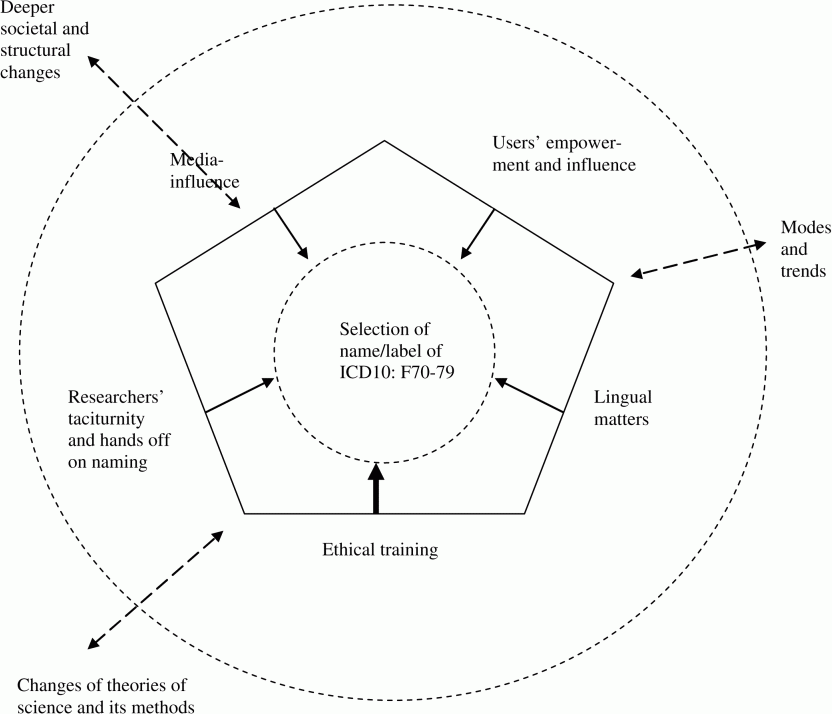
Figure 1. 

The five thematic discourses influencing naming of the diagnosis F70-79 (research question 4).

Note: The peripheral phenomena are seen as’ bigger’ discourses both affecting each other mutually and the five ‘smaller and closer’ research-reported discourses. When arrows go both direction it indicates that there is a reciprocal influence. Thus Figure 1 discloses a chicken-egg question of interpretation.

Language: English
Page range: 56 - 73
Submitted on: Aug 19, 2009
Accepted on: Sep 9, 2010
Published on: Jun 1, 2012
In partnership with: Paradigm Publishing Services

© 2012 Carl Chr. Bachke, published by Stockholm University Press
This work is licensed under the Creative Commons Attribution 4.0 License.