

Figure 1
Timeline of key data collection moments.
Table 1
Data analysis process.
| DATA | CODE | SUBTHEME | THEME |
|---|---|---|---|
| I asked openly to them (the physicians) what they encounter in complex care and what they (the physicians) need. How could we respond to that with training? | Asking the questions ‘what do you need’ at the start of a training | Tailoring the training to the needs of the participants | Training people in GOC towards sustainable implementation |
Table 2
Overview primary care organisations, projects and data.
| PRIMARY CARE ORGANISATION | OVERVIEW PROJECT | AVAILABLE DATA F = FIELD NOTES S = SURVEY I = INTERVIEW | |
|---|---|---|---|
| 1 | Patient organisation | A life path towards goal-oriented care on a human scale. To promote and explain the tools for more goal-oriented care using an example, in order to raise awareness among all stakeholders about their application. Organisation of a conference on GOC and workshops with a tool GOC for patients. | F, S, I |
| 2 | Peer support group | Welcome Home, a first step in peer support towards goal-oriented care. Use a tool to promote dialogue/collaboration between peers with mental vulnerability and care/welfare services, with a view to active co-decision making. Exploration with a tool GOC for citizens, together with volunteers. | F, S, I |
| 3 | Monodisciplinary healthcare centre | (Un)concerned pregnancy: integrating personal concerns into prenatal care. In addition to prenatal care/consultation, develop a tool to assess the needs/wishes of the pregnant woman/partner in advance, using a short questionnaire of concerns. Introduction of a GOC tool and peer learning activities for professionals in the centre. | F, S, I |
| 4 | Multidisciplinary healthcare centre | Healthcare Esperanto Methodology: a shared language for patients, caregivers and professionals. Exploring the methodology within the community health centre to contribute to multidisciplinary consultation and ownership of patients through a shared language around (complex) care questions. Training sessions for professionals and informal caregivers in the centre. Developing GOC processes. | F, S, I |
| 5 | Home care service | Goal-oriented care: care providers and the network as co-pilot for care recipients and informal caregivers. Motivating care recipients who are moving to a residential care centre/assisted living facility to express their concerns and encouraging care providers to respond flexibly to these concerns. Development and implementation of a training for professionals. | F, S, I |
| 6 | Home care service | ‘Person-central’: implementing goal-oriented care in phases and processes Select and test methods with a group of clients/caregivers and provide training for employees to focus on the needs of clients/caregivers. Implementation of a tool GOC for patients and informal caregivers. | F, S, I |
| 7 | Flemish Primary care zone | Expedition goal-oriented care for primary care/welfare actors in Central West Flanders. With primary care actors, led by a guide, actively exploring the diverse landscape of concepts and tools regarding goal-oriented care for people with care/support needs. Coaching and training on GOC for professionals in a geographic region. | F, S, I |
| 8 | Flemish Primary care zone | Goal-oriented work in the Waasland: for a satisfied patient/client and care provider. Explain the principles of goal-oriented work/coaching professionals/central role of the patient to healthcare providers and encourage them to match care wishes and reality. Coaching and training on GOC for professionals in a geographic region. | F, S, I |
| 9 | Flemish Primary care zone | Primary care zone Scheldekracht is enthusiastic about goal-oriented care. From exploration to implementation. To ask the stakeholders involved about their views on (goal-oriented) care and presenting tools, and to support/discuss goal-oriented care in practice. Introduction on GOC for patients and professionals in a geographic region. | F, S, I |
| 10 | Training, scientific support and advocacy organisation (federation, professionnal associations…) | Goal-oriented care in general practice: further training/change of mentality of all employees. Develop a package on goal-oriented care in local quality groups to support general practitioners, based on their own practical experience, in the transition to goal-oriented care. Development of a training package GOC for general practitioners. | F, S, I |
| 11 | Health insurance company | Social work services introduce principles of goal-oriented care in care provision. Develop a training course to help health care workers put the care recipient at the centre within an interdisciplinary approach, aiming at quality of life of clients. Developing GOC processes and the organisation of a conference GOC for social workers. | F, S, I |
| 12 | Multidisciplinary healthcare centre | Better care follow-up of chronic patients in the community health centre. Thinking about developing shared care goals, to unblock seemingly inextricable situations and avoid difficulties. Developing GOC processes and tools. | F, S |
| 13 | Multidisciplinary healthcare centre | For holistic, accessible medicine where patient/life project is central. Empowering patients by informing them/treatment according to their priorities, and developing disease-specific procedures/tools tailored to each patient’s. Developing GOC processes and tools. | F, S |
| 14 | Multidisciplinary healthcare centre | Multidisciplinary working around patients’ life goals in community health centre. Collecting life goals from people with diabetes, people aged 70+ and people with chronic illness, coding them in the patient record, and guiding/supporting the team. Developing GOC processes and the implementation of a GOC tool in the centre. | F, S |
| 15 | Residential care centre | The purpose of life is central to residential care: a multidisciplinary primary care approach. Tailoring care to the hopes, expectations and end of life of WZC residents, contributing to meaning for staff members, and sharing the experience gained. Developing GOC processes and tools. | F, S |
| 16 | Senior citizen organisation | My life book: ‘Will hospital/care center respect my taste, choices, wishes?’ Using an instrument from the elderly association Énéo, provide administrative information and start a dialogue with family members/professionals to ensure that the choices of the elderly are respected. Developing a GOC tool together with the seniors. | F, S |
| 17 | Counselling organisation for older people | How to guide the elderly to a suitable place to live, with a view to their self-determination? Inform the elderly, family members and professionals at an early stage about housing options for the elderly, and visit these with peers (older volunteers) to enable them to make an informed choice. Developing GOC tools. | F, S |
| 18 | Service for people with addiction | To be or not to be: making life goals of addicted patients visible through theatre work. Using the processing of testimonies from/by patients about their addiction/withdrawal process in podcasts/clips/a play as an educational tool and life goal. Group activities to enhance person’s capabilities to define their own goals. | F, S |
| 19 | Housing first organisation | Housing First reconnection team for former homeless people with mental and addiction problems. In addition to psychomedical-social teams, working on people’s life goals, through individual follow-up and participatory community activities. Group activities to enhance person’s capabilities and to follow-up the goals. | F, S |
| 20 | Home care service | Testing a person-centred approach in a home care service in Brussels. Introduce home care nurses to the Montessori method of assistance/care adapted to the elderly and/or people with loss of autonomy, with a view to change. Training for professionals. | F, S |
| 21 | Training, scientific support and advocacy organisation | Users and caregivers: partners in care in a community health centre. Organizing an action research and co-training on goal-oriented care, for an individual and interdisciplinary professional practice focused on the patient’s life goals. Inventory of existing tools on GOC across organisations and supporting member-organisations. | F, S |
| 22 | Training, scientific support and advocacy organisation | Living and growing old in health. To keep doing what you love! To raise awareness among the elderly to regularly optimize the required capacities for their life purpose, in order to maintain their well-being/independence in daily life. Workshops on GOC for older people. Local sessions to support networking between local professionals and authorities. | F, S |
| 23 | Multidisciplinary healthcare centre | The other conversation: is goal-oriented care difficult for socially vulnerable goal-oriented groups? Despite resistance from some physicians, as a care coordinator, continue to strive for the implementation of goal-oriented care at all levels/domains of the primary care organisation. Training sessions for professionals in the centre. Developing GOC processes. | F, I |
| 24 | Social housing company | 3 Zen Age: Spending the autumn of your life in peace, in a group home Develop an Everecity housing project to bring together seniors and surround them with benevolent neighbours and specific health and psychosocial care, provided by professionals. Research for development of a participatory co-housing project for older people. | F |
| 25 | Advocacy, knowledge and network organisation | Putting goal-oriented care into practice locally in public residential care facilities. Organise learning community and offer training and inspiring practices, to write a personal, goal-oriented care story with care recipients. Coaching and training on GOC for professionals in Flanders. | F |
[i] Field notes (F) = 25
Survey (S) = 22
Interviews (I) = 12
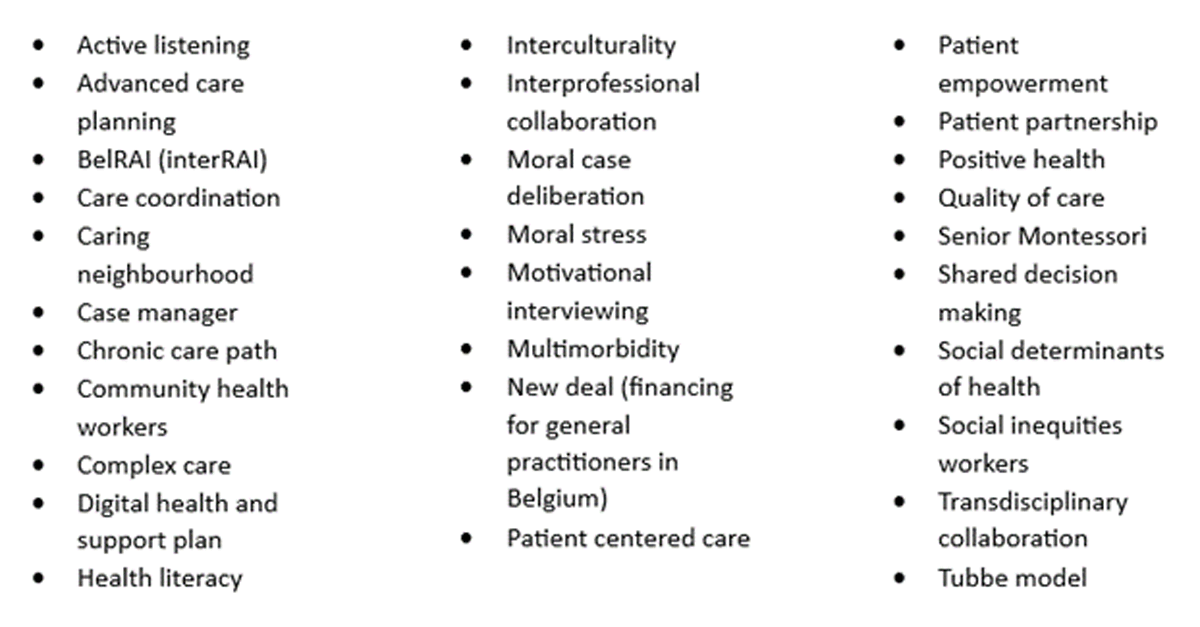
Figure 2
Concepts related to GOC (this list is non exhaustive).