
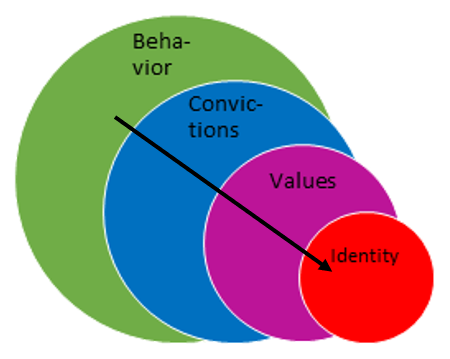
Figure 1
Change depth model [19].
Table 1
Change support-intervention program.
| 1. Forming change coalitions | Who: Teamleads, the project lead and policy advisor How: one meeting of 1 hour When: Q1 2021 Tools & working methods: Coalition formation What: Five change coalitions were made responsible for the design and implementation of the change in their own region. Each regional coalition was composed to consist of a mix of enablers, hotspot leaders and informal leaders [22]. Enablers were teamleads in the organisation with hierarchical power in the region. Each region nominated one teamlead for this task. This person was in turn responsible for putting together a change coalition with hotspot leaders and informal leaders. Hotspot leaders were professionals at crucial positions in the organisation with the ability to make the change a success, such as account managers or care coordinators. Informal leaders were professionals with a natural authority based on their expertise, personality or track record in the region. The size of each regional coalition depended on the number of full-time equivalents [FTEs] per region, ranging from five to eight professionals. The criteria for participation in the coalition was the positive motivation of the professional, and the teamlead’s assessment whether this professional would make an essential contribution to the change task. |
| 2. Onboarding | Who: all members of the five change coalitions How: one meeting of 1,5 hour When: Q1 2021 Tools & working methods: coalition building, alignment creation, formal structuring/embedding, group dialogue. What: Each coalition received instruction by the project lead in one meeting of 1,5 hour about their role as change agent, and about the change approach: ‘the onboarding’. By discussing the project plan and progress of the change with the organisations’ management team, coalitions were also given a clear and strong mandate from the management team and the project lead for their role as change agents. At the start of the project the entire middle management was informed by two members of the project team in a meeting and had the opportunity to ask questions and raise concerns about the project and the change approach. |
| 3. Learning expeditions | Who: all members of the five change coalitions How: 4 online meeting of 3 hours When: Q1 en Q2 2021 Tools & working methods: Visioning, Golden Circle [26], Change Canvas template [22], building a collective learning mindset [e.g. experimenting], broadening/extending the coalition base. What: The change coalitions were asked to design and define integrated youth care at Youké in a learning expedition. We applied methods in the spirit of dialogic organisation development [25] to facilitate collective learning. Due to Covid-19 measurements, four digital meetings took place digitally once a month, which lasted three hours each. In the first meeting we focused on the ‘why’ of the change to integrated care, to create a sense of need and common understanding among the change coalitions. In the second and third meeting, we paid attention to the ‘how’ and ‘what’ of the change process. During the fourth meeting, we discussed how to disseminate the change assignment from the level of the coalitions to the other professionals in the organisation and how they could be included in the change. The coalitions were then invited to organise expeditions within their own region, to start the dialogue about changing towards integrated care and to take the lead in implementing this further in their own region. |
| 4. Coaching sessions | Who: all members of the five change coalitions How: Four online meeting of 3 hours When: one meeting in between learning expedition one and two and two meetings after the learning expeditions in Q1, Q2 and Q3 2021 Tools & working methods: learning sessions/lessons sharing, feedback, carry forward of learning. What: The coalitions had separate meetings with members of the project team in between the learning expeditions and twice after the expeditions were finished, to discuss the implications of the expedition with each other, and to further elaborate their plans. In these meetings, each coalition received coaching on their role and task as a change agent by members of the project team. Themes that were covered and discussed during these coaching sessions were issues such as dealing with change uncertainty, handling resistance, and maintaining the focus on the desired behavioural change. |
| 5. Training case conceptualisation | Who: Two members of each change coalition [n = 10] How: Four meeting of 3,5 hours When: Q3 2021 Tools & working methods: formal training [7-factors model] What: Ten participants received in-depth training about how to utilise the 7-factors model while performing a clinical case conceptualisation. |
Table 2
Member composition of the five change coalitions.
| FUNCTION | ROLE IN THE CHANGE PROCESS |
|---|---|
| Change coalition 1 | |
| Teamlead [n = 2] | Enabler |
| Psychologist [n = 1] | Informal leader |
| Psychologist and care coordinator [n = 1] | Informal leader |
| Account manager [n = 1] | Hotspot leader |
| Youth care professional [n = 4] | Informal leaders |
| Change coalition 2 | |
| Teamlead [n = 1] | Enabler |
| Psychologist [n = 1] | Hotspot leader |
| Youth care professionals [n = 5] | Informal leaders |
| Change coalition 3 | |
| Teamlead [n = 1] | Enabler |
| Care coordinator [n = 1] | Hotspot leader |
| Youth care professionals [n = 2] | Informal leaders |
| Change Coalition 4 | |
| Teamlead [n = 1] | Enabler |
| Psychologist [n = 1] | Informal leader |
| Care coordinator [n = 1] | Hotspot leader |
| Youth care professionals [n = 3] | Informal leaders |
| Change Coalition 5 | |
| Teamlead [n = 2] | Enabler |
| Psychologist [n = 1] | Hotspot leader |
| Psychologist and care coordinator [n = 1] | Hotspot leader |
| Youth care professionals [n = 3] | Informal leaders |
[i] Note: Youth care professionals are professionals with a higher vocational level of education in social work or pedagogics, who provide care to the families in the regions.
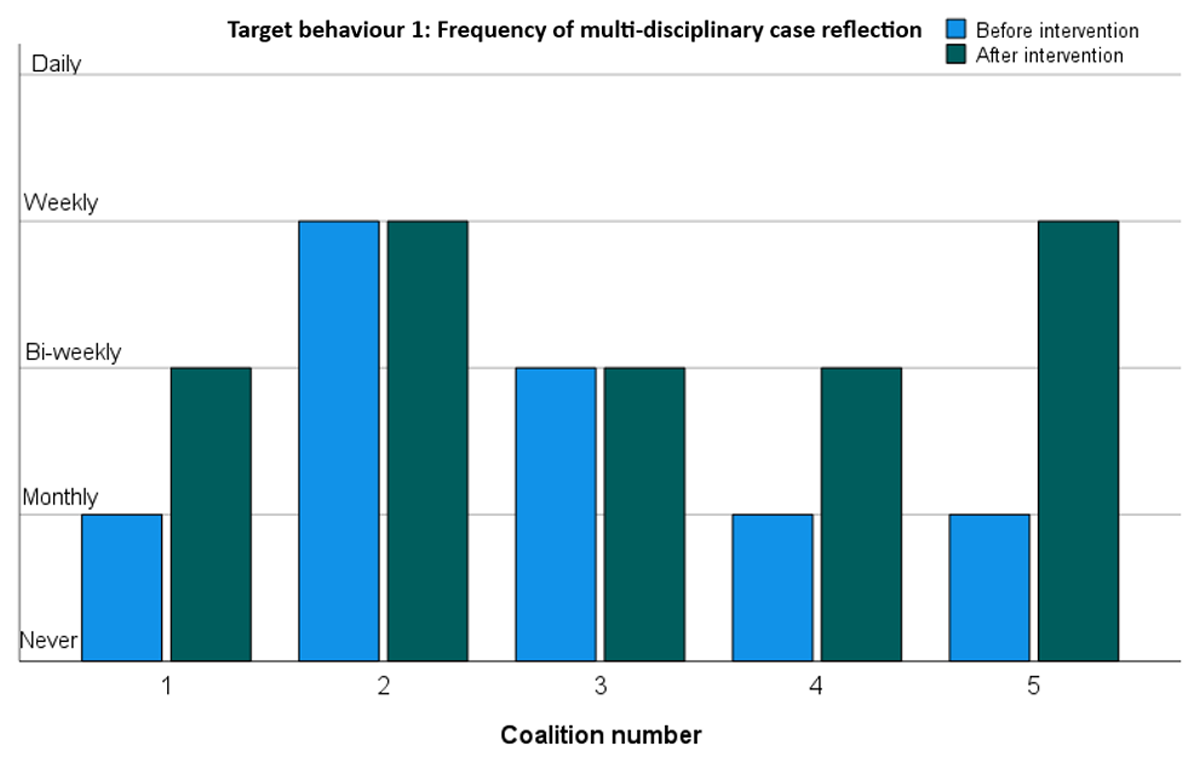
Figure 2
Frequency of multi-disciplinary case reflection.
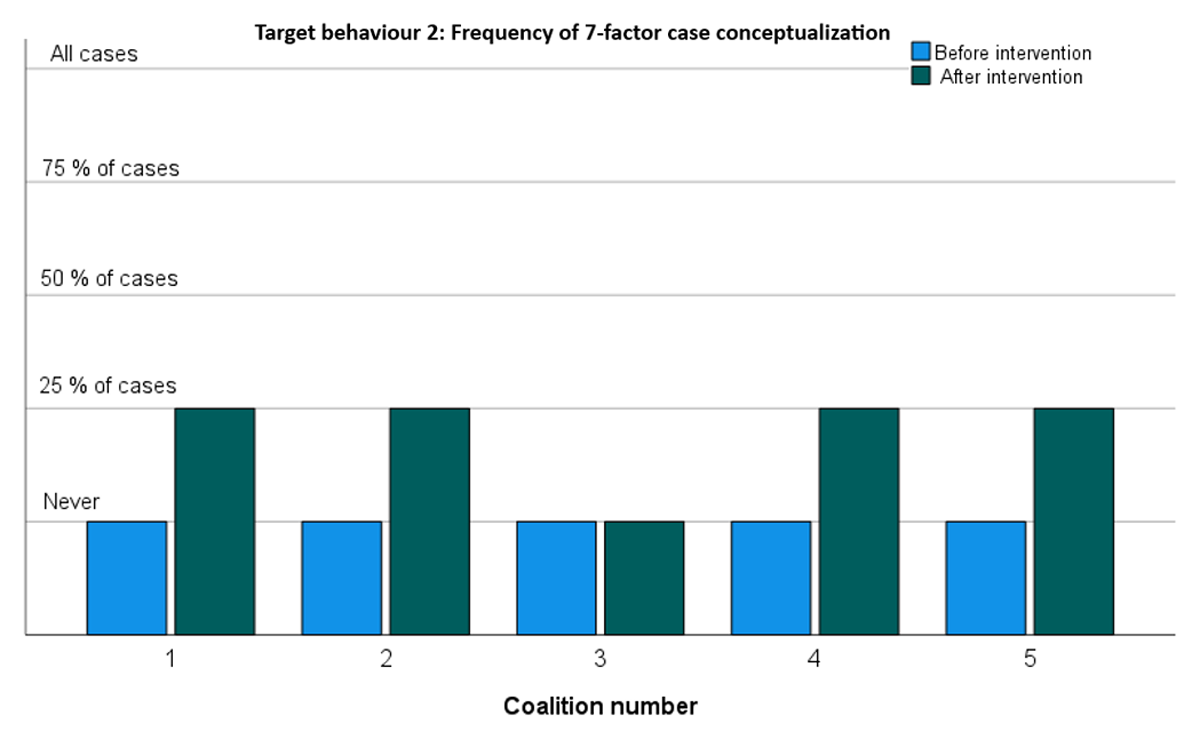
Figure 3
Frequency of 7-factor case conceptualization.
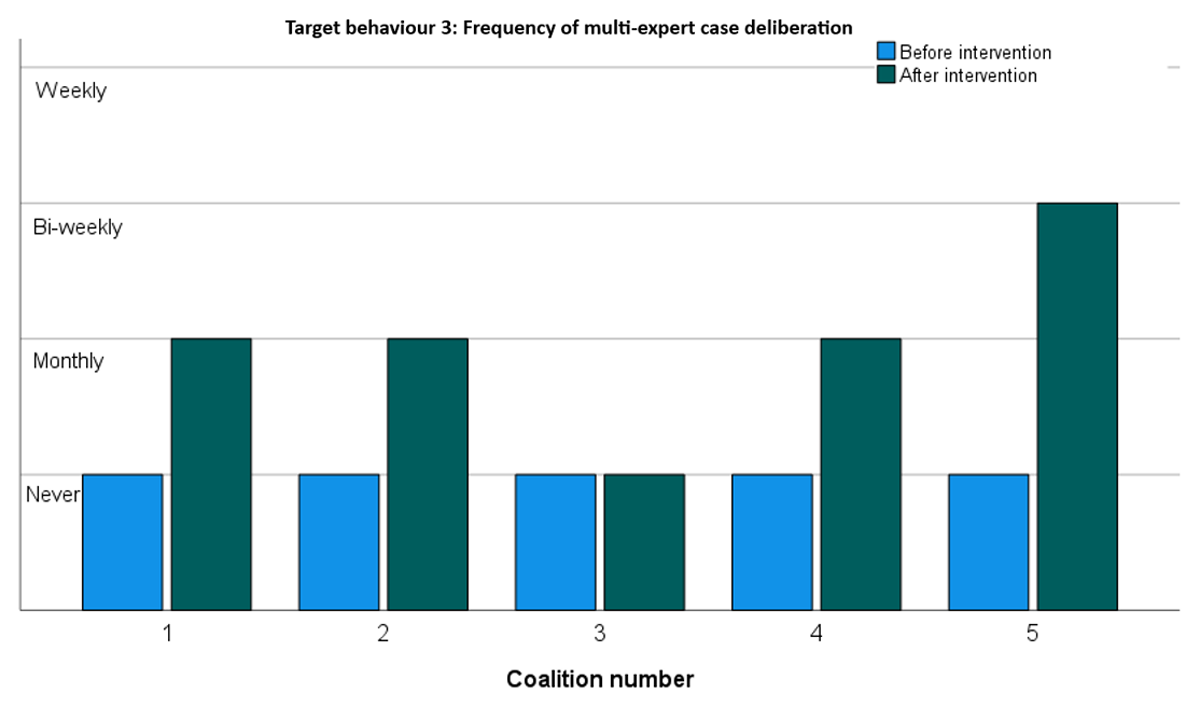
Figure 4
Frequency of multi-expert case deliberation.

Figure 5
Frequency of colleague support towards multi-expert case deliberation.