Figure 1:

Figure 2:
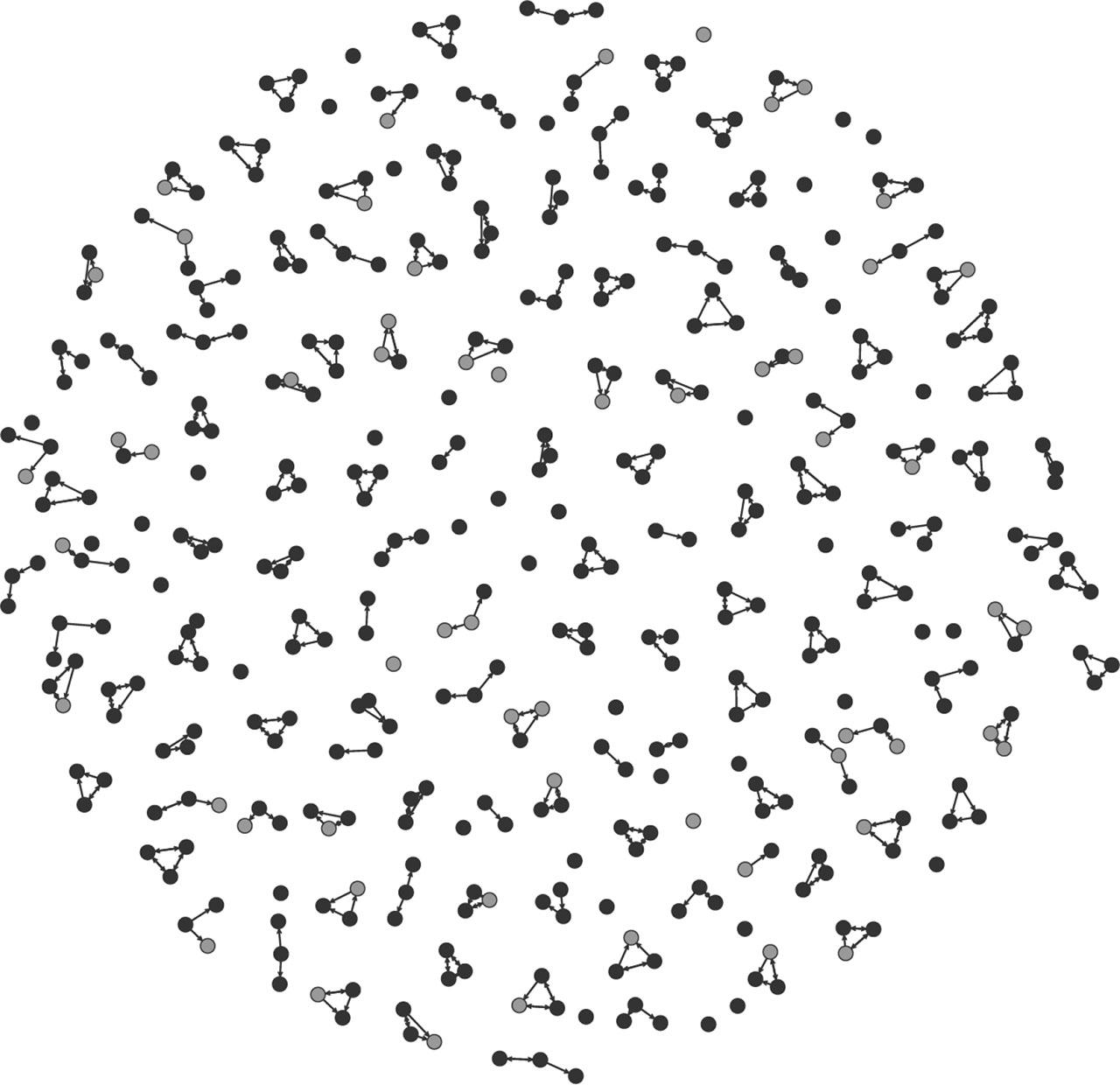
ERGM revealing the impact of deep-level homophily on social tie formation_
| Parameter | Liking | Trust | ||||
|---|---|---|---|---|---|---|
| Effect estimate | SE | Odds ratio | Effect estimate | SE | Odds ratio | |
| Covariates | ||||||
| edges | 2.45* | 0.71 | — | 1.60* | 0.48 | — |
| nodeifactor | ||||||
| Nonheterosexual | −0.64 | 0.50 | 0.53 | −0.07 | 0.37 | 0.93 |
| Republican | 0.31 | 0.47 | 1.36 | −0.29 | 0.28 | 0.75 |
| Other political preference | −0.14 | 0.38 | 0.87 | −0.24 | 0.26 | 0.79 |
| Female | −0.10 | 0.39 | 0.90 | −0.09 | 0.26 | 0.91 |
| Other gender | 1.08 | 0.86 | 2.94 | 0.39 | 0.61 | 1.48 |
| nodeofactor | ||||||
| Nonheterosexual | 0.76 | 0.60 | 2.14 | 0.28 | 0.38 | 1.32 |
| Republican | 0.28 | 0.45 | 1.32 | 0.19 | 0.30 | 1.21 |
| Other political preference | 0.13 | 0.39 | 1.14 | −0.05 | 0.26 | 0.95 |
| Female | −0.29 | 0.40 | 0.75 | −0.19 | 0.26 | 0.83 |
| Other gender | −1.47 | 0.84 | 0.23 | −0.38 | 0.60 | 0.68 |
| nodematch | ||||||
| Gender | 0.07 | 0.39 | 1.07 | 0.08 | 0.25 | 1.08 |
| Deep-level homophily (nodematch) | ||||||
| Sexual orientation | −0.06 | 0.48 | 0.94 | −0.14 | 0.35 | 0.87 |
| Political preference | 0.24 | 0.36 | 1.27 | −0.12 | 0.23 | 0.89 |
Binary logistic regression predicting performance for lowest- and highest-performing teams (t = 113)_
| Parameter | Beta | SE | Odds ratio |
|---|---|---|---|
| Gender diversity (covariate) | −1.34 | 1.21 | 0.26 |
| Sexual orientation diversity | −0.08 | 1.22 | 0.92 |
| Political preference diversity | 2.25* | 1.23 | 9.52 |
ERGM revealing the impact of deep-level homophily on task-relevant tie formation_
| Parameter | TMS | Hindrance | ||||
|---|---|---|---|---|---|---|
| Effect estimate | SE | Odds ratio | Effect estimate | SE | Odds ratio | |
| Covariates | ||||||
| edges | −5.98*** | 0.27 | — | −10.05*** | 0.85 | — |
| nodeifactor | ||||||
| Nonheterosexual | 0.06 | 0.21 | 1.06 | 0.72 | 0.47 | 2.05 |
| Republican | 0.16 | 0.18 | 1.17 | 0.12 | 0.44 | 1.13 |
| Other political preference | 0.18 | 0.15 | 1.20 | 0.17 | 0.36 | 1.19 |
| Female | −0.02 | 0.15 | 0.98 | 0.66 | 0.54 | 1.93 |
| Other gender | −0.43 | 0.34 | 0.65 | −0.44 | 0.98 | 0.64 |
| nodeofactor | ||||||
| Nonheterosexual | −0.44 | 0.22 | 0.64 | −0.52 | 0.55 | 0.59 |
| Republican | −0.33 | 0.18 | 0.72 | −0.55 | 0.54 | 0.58 |
| Other political preference | 0.09 | 0.15 | 1.09 | 0.55 | 0.34 | 1.73 |
| Female | 0.02 | 0.15 | 1.02 | 1.14* | 0.56 | 3.13 |
| Other gender | 0.45 | 0.35 | 1.57 | 1.86* | 0.85 | 6.42 |
| nodematch | ||||||
| Gender | 0.41** | 0.14 | 1.51 | −0.28 | 0.52 | 0.76 |
| Deep-level homophily (nodematch) | ||||||
| Sexual orientation | −0.41* | 0.20 | 0.66 | 0.55 | 0.45 | 1.73 |
| Political preference | 0.12 | 0.14 | 1.13 | 0.69* | 0.31 | 1.99 |