Have a personal or library account? Click to login
Networks of Influence in Scottish Enlightenment Publishing Cover

Networks of Influence in Scottish Enlightenment Publishing

By: Yann Ryan and  Mikko Tolonen  
Open Access
|May 2024

Figures & Tables

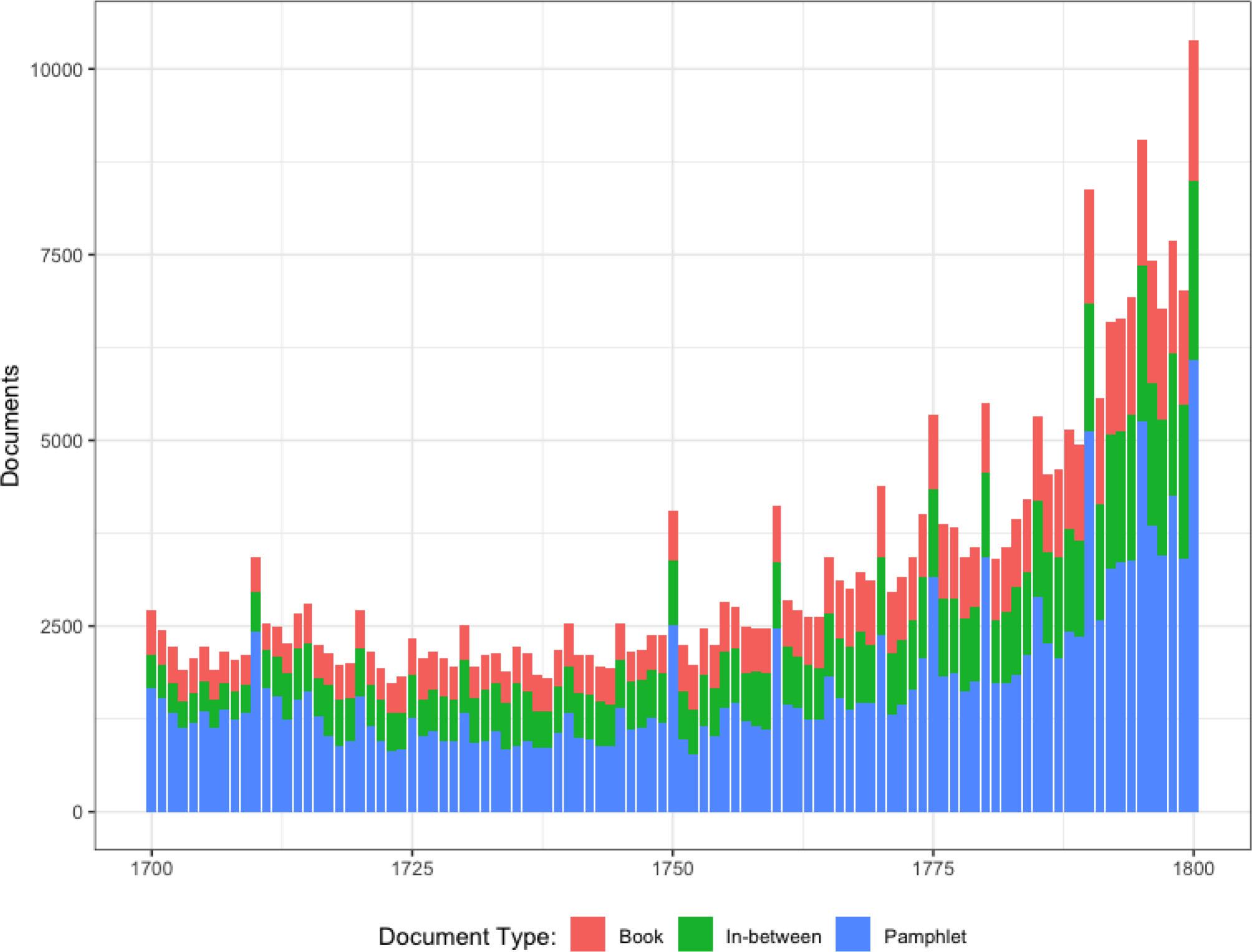
Figure 1:

Graph of the number of records per year for each document type in the ESTC, from 1700–1800. The definitions of these document types have fuzzy boundaries. For our purposes, we count any document of between 1 and 32 pages as a pamphlet, between 33 and 128 as an “in-between,” and over 128 as a book. ESTC, English Short Title Catalogue.

Figure 2:

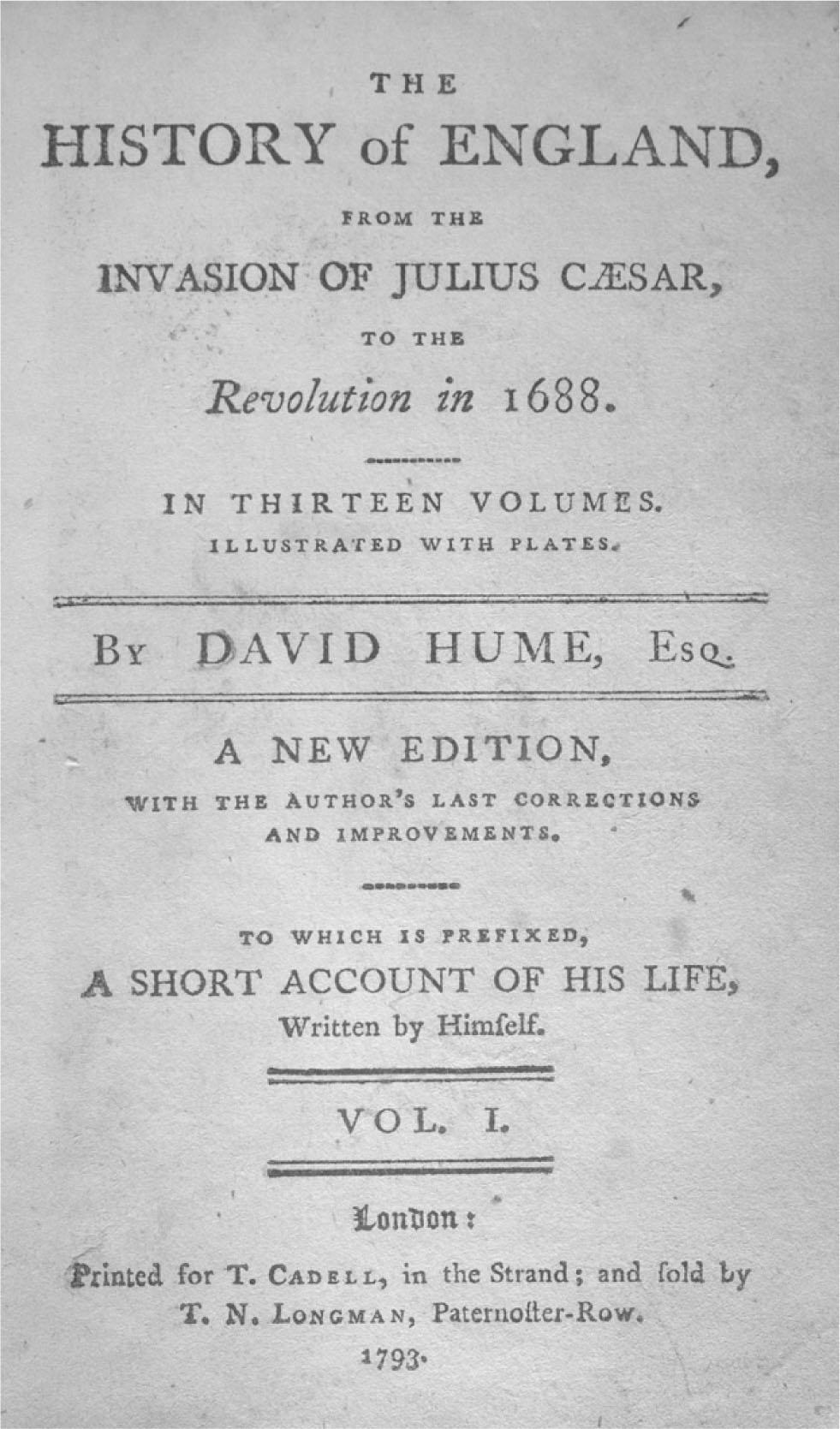
An example of a typical 18th century book title page. Most included information about the author, date, place of publication, as well as its publishers, booksellers, and printers, which has been recorded as structured data in the ESTC. Image from https://digital.library.mcgill.ca/hume/search/large.php?id=8832. ESTC, English Short Title Catalogue.

Figure 3:

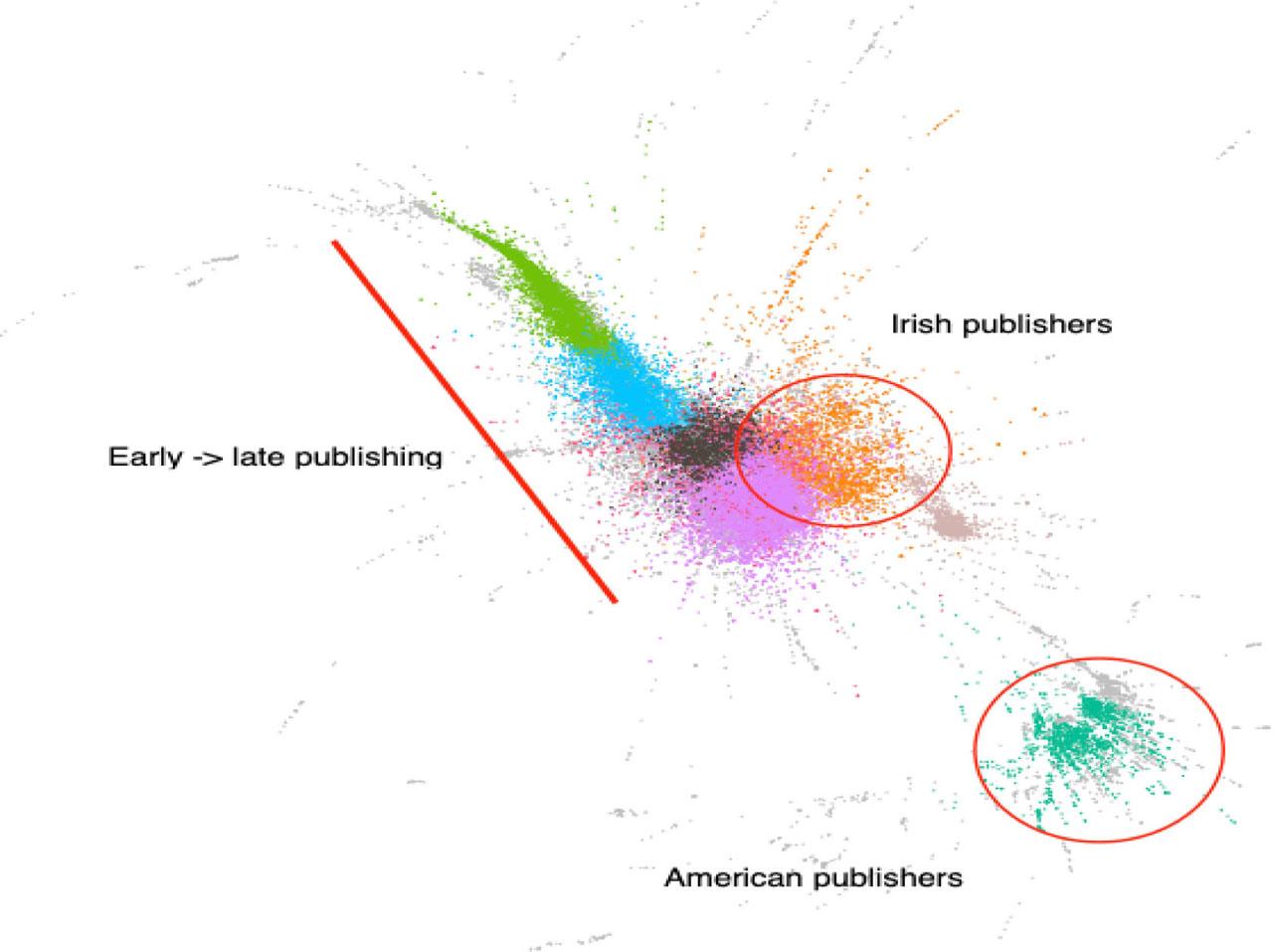
Force-directed network of the entire ESTC dataset (1473–1800) with Louvain community detection labels. Edges have been removed for readability. As the data is longitudinal and passes through multiple generations of individuals, its connections are mostly temporal, resulting in the elongated shape of the main component, consisting of a series of subgroups that are connected in series rather than all to each other. Scottish publishers are mostly distributed along this part of the network: the green, blue, brown, and pink clusters. Also visible is an Irish cluster (in orange), and a more distant American cluster (in green). ESTC, English Short Title Catalogue.

Figure 4:

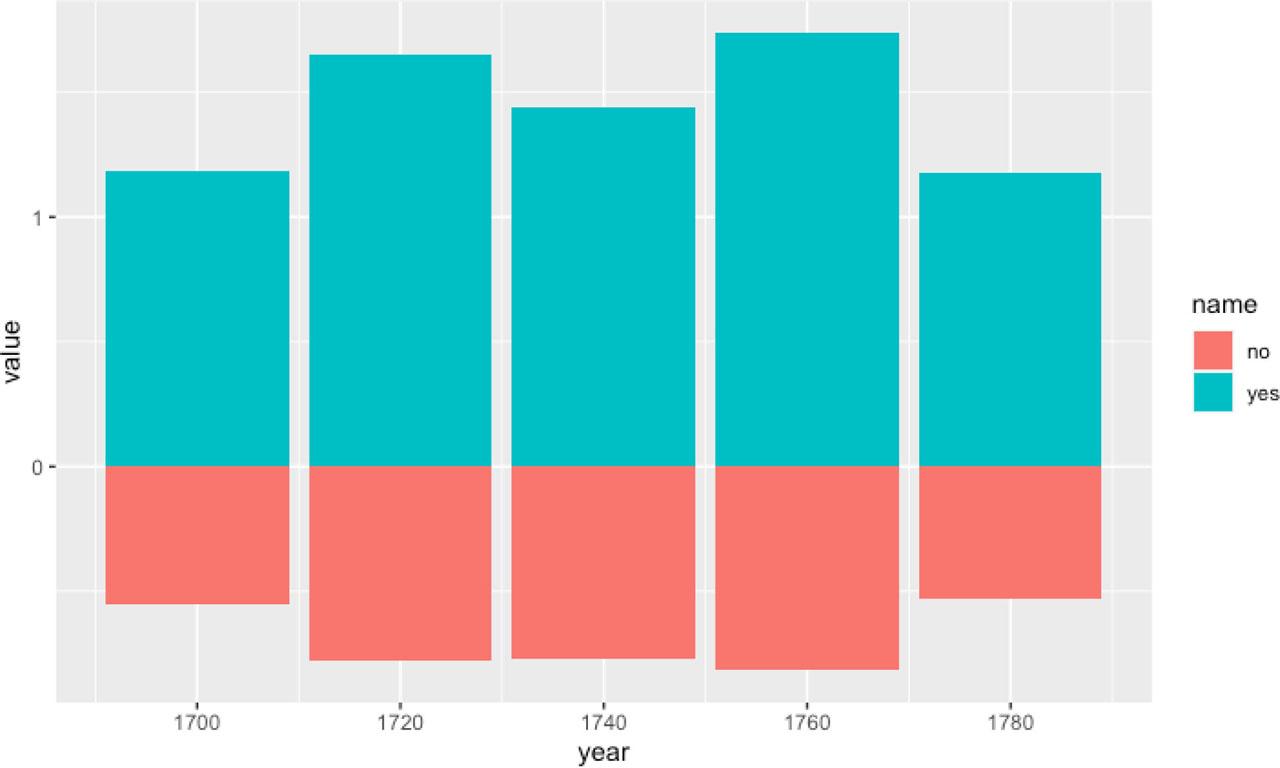
Coefficients (not probabilities) for Scottish and non-Scottish publishers, over time. Non-Scottish is consistently below zero, meaning that if both nodes were not Scottish, the probability of a tie moderately decreased.

Figure 5:

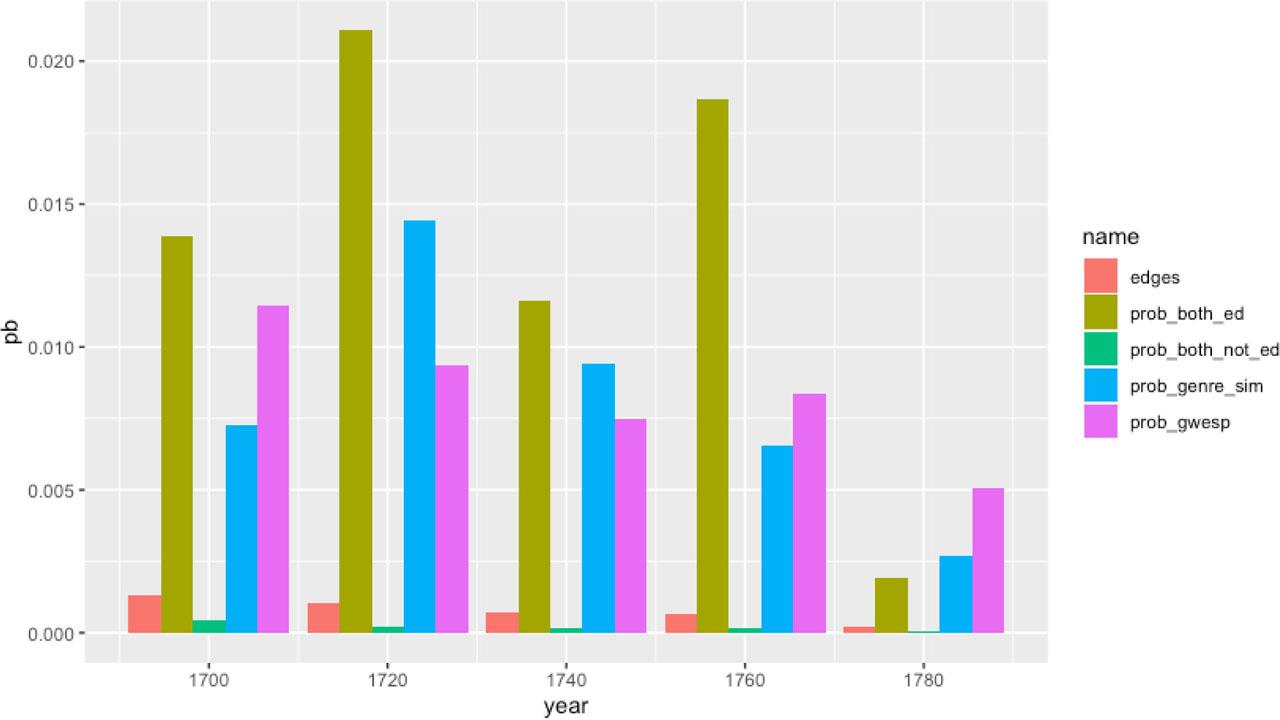
Probabilities per decade for a number of key coefficients. These suggest that in general the impact of two nodes being Scottish publishers on the probability of a tie lessened over the century, in favor of genre similarity and network effects (edgewise shared partners).

Log-odds for all covariates used by the model_

Time slice17001720174017601780
Edges6.63***6.92***7.29***7.48***8.41***
0.080.080.080.110.07
nodematch.is_ed.no0.55***0.81***0.77***0.80 ***0.57***
0.030.040.040.070.06
nodematch.is_ed.yes1.14***1.52***1.40***1.67***1.20***
0.060.050.040.060.11
nodecov.p_scot00.02**0.01**0.02***0.01
0.010.01000.01
gwesp.fixed.0.012.17***2.24***2.38***2.61***3.11***
0.060.070.070.090.08
nodematch.actor_gender.female0.250.311.02*InfInf
0.420.330.41
nodematch.actor_gender.male0.23***0.10***0.18***0.30***0.19***
0.020.030.030.050.04
absdiff.p_scot0.04***0.02**0.04***0.03***0.02*
0.010.010.010.010.01
absdiff.publication_year0.05***0.09***0.08***0.08***0.07***
0000.010
edgecov.dist1.72***2.70***2.63***2.44***2.49***
0.060.060.060.070.08

Overview of node and edge attributes derived from ESTC data_

AttributeTypeDescription
Percentage of Scottish workNodeProportion of work published by Scottish authors
“Scottish publisher”NodeBinary attribute, defined as any publisher whose publication list was at least 25% works by the above Scottish authors. The 25% threshold was chosen after some experimentation—because most publishers published mostly English works, a higher threshold meant not including many important Scottish publishers.
Edinburgh publisherNodeAt least 50% Edinburgh publications, regardless of the likely author nationality.
Scottish similarityEdgeThe difference in percentage points of the volume of Scottish works published by each node in a pair.
Genre similarityEdgeGenre information was turned into an edge attribute: the number of publications for each publisher in each genre was expressed as a vector, and a similarity matrix was made using the cosine distance between each pair.
Publisher genderNodeEstimated using a rule-based approach on first names
Earliest year publishedNodeYear of first record in the ESTC.
Total worksNodeTotal count of records in the ESTC

Network statistics for each time slice_

17001720174017601780
Total nodes7448108081,2071,850
Number of components (size of largest)16 (708)12 (785)12 (784)26 (1,103)25 (1,782)
Number of edges4,9067,0586,66812,05315,519
Average degree13.1917.4316.519.9716.78
Global clustering coefficient0.310.340.360.380.33
Average local clustering0.560.680.690.740.71
Density0.01770.02150.02050.01660.0091
Modularity (with Louvain)0.340.270.310.270.4
Average distance3.092.882.952.93.15
Booka15,81019,51917,64426,25030,263
In-between10,73012,91612,88216,78723,927
Pamphlet15,8228,54410,20310,61117,513
NA1,3782,3232,5494,3705,345
DOI: https://doi.org/10.21307/connections-2019.034 | Journal eISSN: 2816-4245 | Journal ISSN: 0226-1766
Language: English
Page range: 33 - 46
Published on: May 18, 2024
Published by: International Network for Social Network Analysis (INSNA)
In partnership with: Paradigm Publishing Services
Publication frequency: 1 issue per year

© 2024 Yann Ryan, Mikko Tolonen, published by International Network for Social Network Analysis (INSNA)
This work is licensed under the Creative Commons Attribution 4.0 License.